

House View Q1 2026: Discipline and diversification

Our view of global markets
Bending not breaking
- The global economy enters 2026 bending but not breaking. Growth should remain near trend, supported by easier fiscal and monetary policy, healthy private-sector balance sheets, and structural tailwinds from AI. Inflation is uneven and sticky – largely due to the US – but trending lower elsewhere. While fundamental and political uncertainty stays elevated, we believe it has passed its peak – although investors should monitor any market volatility in anticipation of the US midterms or Fed chair transition.
- This backdrop is favourable for risk assets, even as we acknowledge that we are in a late-cycle expansion where potential rewards may be lower and potential risks higher than in previous quarters. Geopolitical risk cannot be ignored – as the US intervention in Venezuela at the start of the year reminds us.
- For investors, AI remains a critical theme – but one to approach with discipline and diversification. We do not believe the sector is in bubble territory, and missing out on further upside could be costly. However, concentration risk is real. The opportunity set is broadening to applications driving demand for computing power, energy, and enabling tech. This calls for a diversified approach: across tech subsectors, geographies and adjacent innovation themes. At the same time, investors should monitor credit default swap spreads for major AI firms, which could signal emerging credit risks.
- Overall, we have raised our pro-risk stance, favouring diversification across asset classes and geographies. Europe offers selective opportunities despite fading momentum in some markets, while Asia remains undervalued in both equities and FX. Pairing exposure to structural growth drivers like AI with positions in emerging markets, precious metals, and undervalued currencies can help balance risk and reward in what we expect to be a resilient yet complex year where active management will be critical.

Chart of the quarter
Is US growth inclusive?
At first glance, the US economy looks resilient. But dig deeper, and the picture becomes more uneven. A “K-shaped” economy is taking hold: the upper arm of the K reflects higher-income households continuing to spend freely, while the lower arm shows lower-income Americans squeezed by persistent price pressures. If this divergence persists, questions could emerge about the durability of growth.
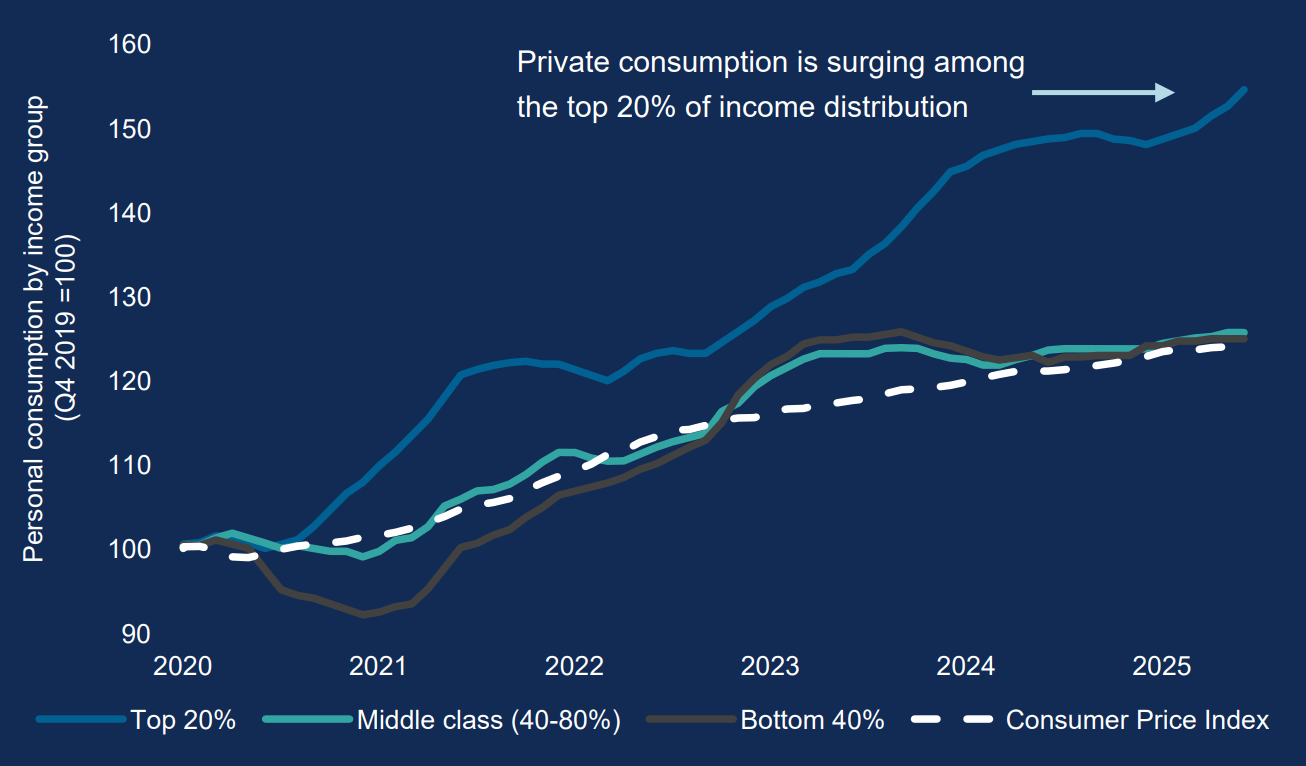
Note: Private consumption based on Moody’s calculations (through Q2 2025). Source: Moody's and Bloomberg.
Short on time? Download the summary of our House View Q1.